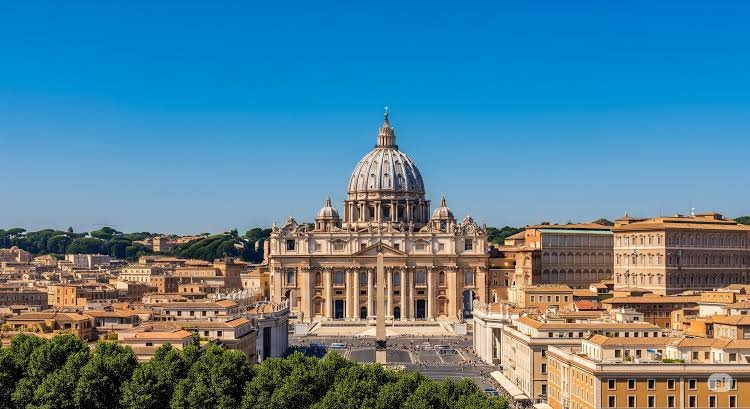
St. Peter's Basilica is significant to Catholic religious practice not simply because it houses a relic, but because it is the single site where the entire arc of Catholic sacramental life, from baptism into the church to the veneration of a martyr's grave, is enacted and monumentalized. Understanding why requires looking past the building's grandeur to two things: what the church has always taught these rituals mean, and where, historically, that meaning actually came from.
Catholic teaching holds that no one is born a Christian; one must be reborn through baptism, an act understood as dying with Christ and rising as a member of his body, the church. This incorporation into Christ's body is deepened through confirmation, in which a priest anoints the confirm with chrism, and through admission to the eucharist, which for Catholics finalizes full membership in the church community. These stages of initiation are sustained, as the textbook explains, through public worship conducted in buildings understood not as mere meeting-houses but as temples; spaces made sacred through holy objects, relics, an altar, and architecture using focused light, imposing height, and acoustic resonance to separate the sacred from the ordinary. St. Peter's Basilica is the maximal expression of that temple ideal: it is where the pope often baptizes, confirms, and celebrates the eucharist on behalf of the universal church, giving the ordinary sacraments of Catholic initiation their most authoritative possible setting.
That same logic of sacred proximity governs the other end of Catholic life. Under Roman persecution, Christians executed for refusing to worship the state gods were venerated by fellow believers as martyrs whose deaths imitated Christ's own sacrifice; their graves became sites of intercession rather than mere burial markers. Peter, among the earliest and most prominent Christians executed by Rome, was venerated in precisely this way, and Catholic tradition holds his tomb lies directly beneath the basilica's high altar. Renaissance architects reinforced this symbolism deliberately, remodeling the basilica along lines evoking Solomon's Temple to position the site as a new seat of religious authority.
What ties these two ends of Catholic ritual life together, however, is not purely doctrine but also domestic practice. Dr. Sharon Mogen's research on death ritual in late antiquity shows that for much of late antiquity many rituals surrounding death remained largely under household rather than ecclesiastical control, and specifically to women, who prepared bodies for burial, led lamentation, and, crucially for a site like St. Peter, collected and transferred martyrs' relics, made pilgrimages to relic sites bearing offerings, and served as patrons who financed and maintained the shrines built over martyrs' graves. Mogen traces how this originally private, women-led devotion was only gradually absorbed into official Catholic liturgy: that these domestic customs influenced the liturgical traditions preserved in the Vatican Gelasian Sacramentary, whose prayers contributed to the medieval rites that the Council of Trent formally reaffirmed as the sacrament of Extreme Unction in 1551. St. Peter's Basilica therefore monumentalizes a devotional pattern with genuinely humble, domestic origins, the same impulse that once led an ordinary family to tend a relative's grave now anchors the ritual center of the entire Catholic Church, just as the sacraments of baptism and confirmation performed there trace back to rituals every Christian household once practiced on its own.
Steven Hooper's cross-cultural theory of relics explains why this history still matters for practice today. Hooper argues relics operate through a "mechanism of transfer and equivalence," whereby proximity to a sacred figure's remains is believed to carry that figure's power into the present. For a Catholic pilgrim, then, standing at St. Peter's is not sightseeing; it is participation in an unbroken chain of devotion running from an ordinary household grave in late antiquity to the altar over an apostle's tomb; the same chain that, at the opposite end of life, begins for every Catholic with the waters of baptism.
References
Campbell, Ian. "The New St Peter's: Basilica or Temple?" Oxford Art Journal 4, no. 1 (1981): 3–8.
Deming, Will, ed. Understanding the Religions of the World: An Introduction. Chichester, West Sussex: John Wiley & Sons, 2015.
Hooper, Steven. "A Cross-Cultural Theory of Relics: On Understanding Religion, Bodies, Artefacts, Images and Art." World Art 4, no. 2 (2014): 175–207.
Mogen, Sharon. "Death, Dying, and Funeral Rites of Christians in Late Antiquity." Guest lecture, RELS 201: Jews, Christians, and Muslims. University of Calgary. January 2022.
Mogen, Sharon Lorraine Murphy. Women and Death Rituals in Late Antiquity: Forming the Christian Identity. Master's thesis, University of Calgary, 2011. https://doi.org/10.11575/PRISM/15912.